As the intelligence era begins in earnest, big tech companies' battle for semiconductor independence is crossing a critical threshold.
[Image: /stdaily/uploads/202606/gen_6a3f138fc8cb89.13142528.png]
Executive Summary
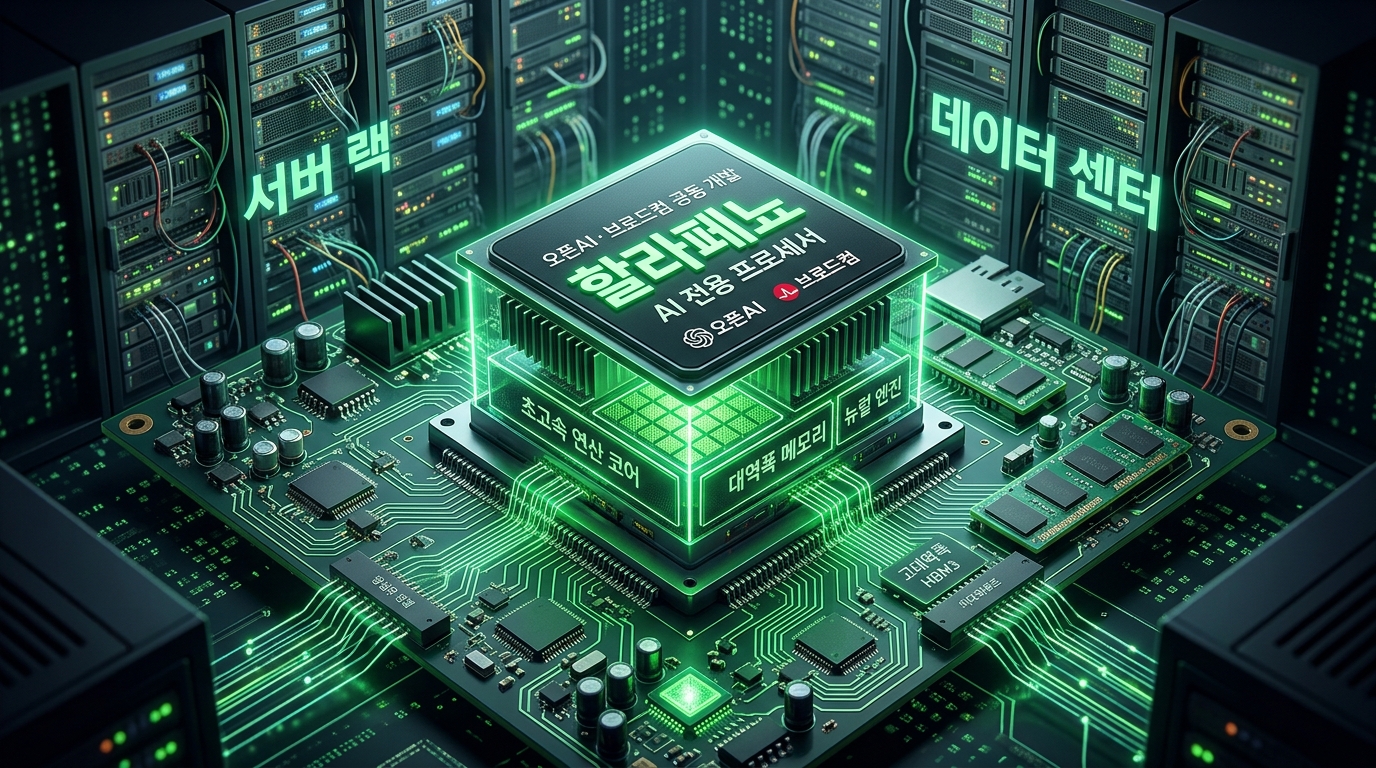
OpenAI and Broadcom have taken their first steps toward hardware self-reliance by unveiling 'Jalapeño,' a proprietary accelerator specialized in Large Language Model (LLM) inference.
This chip was completed in just 9 months from the start of design to foundry tape-out, and has been shown to reduce inference costs by up to 50% compared to existing Nvidia GPUs.
At the same time, Alphabet (Google) has extended its partnership with Broadcom until 2031, solidifying its Tensor Processing Unit (TPU) ecosystem while also seeking diversification through cooperation with companies like MediaTek.
The rise of custom Application-Specific Integrated Circuits (ASICs) signals a meaningful shift in Nvidia's monopoly and has established itself as a powerful core driver of Broadcom's long-term growth.
Current Market Situation
On June 24, 2026 (local time), OpenAI and Broadcom sent shockwaves through the semiconductor industry by revealing a prototype of 'Jalapeño,' their jointly developed inference-specific system.
This chip is a custom-designed accelerator (ASIC) built from the ground up based on operational experience from ChatGPT and Codex. It is scheduled to be deployed in actual data centers for the first time late this year using TSMC's 3-nanometer (nm) process.
Alphabet (Google) is also focusing all its efforts on maximizing hardware efficiency by strengthening its proprietary AI semiconductor TPU v8 lineup.
Google extended its long-term contract with Broadcom until 2031, while also agreeing to supply Anthropic with 3.5 gigawatts (GW) of next-generation TPU computing capacity starting in 2027.
Regarding the macroeconomic environment as of June 27, 2026, the Nasdaq index stands at 25,297.62 points, and the USD/KRW exchange rate has reached 1,535.80 KRW, maintaining high interest rates and strong dollar pressure.
As a result, defending multiples across tech stocks has become crucial, and according to the Daily Stock Fear & Greed Index, the Nasdaq has entered the 'Fear (24.8)' zone, reflecting heightened volatility.
Financial Analysis
Broadcom's AI semiconductor revenue is growing at a remarkable pace each quarter, silencing market skeptics.
In the first quarter of fiscal year 2026, Broadcom's AI revenue reached $8.4 billion, a 106% surge year-over-year, while Q2 guidance was presented at $10.7 billion.
The company maintains its enterprise-wide goal of achieving over $100 billion in annual AI chip revenue by 2027, with a backlog approaching $73 billion.
Additionally, the joint development of multi-generational custom accelerators with OpenAI and the massive TPU deployment contract with Anthropic are key factors further reinforcing long-term earnings visibility.
Broadcom (AVGO) AI Semiconductor Revenue Trend and Guidance (2025~2027)
| Segment | Q2 2025 | Q3 2025 | Q4 2025 | Q1 2026 | Q2 2026 (Guidance) | 2027 Target (Annual) |
|---|---|---|---|---|---|---|
| AI Semiconductor Revenue ($ Billion) | 4.4 | 5.2 | 6.2 | 8.4 | 10.7 | 100.0+ |
Google is also expecting astronomical infrastructure revenue from its alliance with Anthropic.
According to industry sources, establishing 1 gigawatt (GW) of power infrastructure and chip facilities costs between $35 billion and $50 billion. Thus, Anthropic's multi-GW contract carries potential knock-on effects worth hundreds of billions of dollars over the long term.
Valuation
Broadcom is evaluated as sitting in a relatively reasonable valuation territory among large-cap AI tech stocks.
It is trading at approximately 25 times its 12-month forward price-to-earnings (Forward P/E) ratio, which is interpreted by some as undervalued considering its earnings growth rate and visibility.
The long-term supply contract with Google until 2031 and the solid alliance with OpenAI serve as a powerful safety net protecting Broadcom's financial performance even during temporary semiconductor down-cycles.
Unlike general-purpose GPUs, the custom silicon (XPU) market tailored perfectly to specific corporate workloads holds the structural advantage of maintaining stable margin structures.
Alphabet (Google) is also saving on the massive premium margins it would otherwise pay to Nvidia by internalizing its proprietary TPU ecosystem.
This proprietary chip design capability improves Alphabet's capital expenditure (CAPEX) efficiency and supports its mid-to-long-term valuation multiples.
Expert & Institutional Analysis
Global research firm Morningstar reaffirmed Broadcom's Wide Moat and maintained its fair value estimate at $650 per share.
They assessed that concerns raised by some in the market regarding Google losing TPU design market share are exaggerated, and that diversification into OpenAI and Anthropic will be more than enough to offset any potential gaps.
Brendan Burke, an analyst at The Futurum Group, commented that Jalapeño's '9-month tape-out' achievement has shifted the paradigm in chip design history.
He emphasized that OpenAI's proprietary LLM contributed to optimizing semiconductor placement and networking design, completing a cyclical mechanism where AI directly designs the hardware that runs itself.
Counterpoint Research highlighted the macroeconomic trend of Google pursuing supply chain disaggregation by partnering with MediaTek for its inference chip, the TPU v8i.
While this disaggregation is a natural choice for Big Tech to reduce markup costs, they projected that Broadcom's dominant position in core networking and training main die design will remain secure for at least five years.
Risk Factors
The most immediate physical bottleneck is TSMC's advanced packaging (CoWoS and next-generation stacking technologies) supply limitations.
No matter how outstanding an architecture is designed, if manufacturing and packaging capacity cannot support it, actual deployment speeds could be delayed, postponing revenue realization.
[Image: /stdaily/uploads/202606/gen_6a3f139b08e926.55490984.png]
Additionally, financial risks associated with large startups represent a potential hazard for Broadcom.
For example, the terms of the 3.5 GW supply agreement with Anthropic include a clause stating 'subject to continued commercial success,' leaving open the possibility that the contract size could be reduced if AI service monetization is delayed or cash reserves run low.
Finally, attempts by Big Tech companies to reduce framework lock-in through deeper vertical integration present a long-term variable.
If compatibility conflicts or software optimization issues arise as proprietary chip accelerators seek general-purpose capabilities, it could lead to side effects that lower efficiency relative to initial investments.
Investment Outlook Summary
Despite rising stock market volatility and the Nasdaq entering the Fear (24.8) stage, the shift toward custom silicon (ASICs) is an unstoppable megatrend.
Movements by Big Tech firms to secure proprietary chips due to margin pressures from Nvidia's general-purpose GPUs structurally benefit custom design leaders like Broadcom.
Rather than focusing on short-term quarterly fluctuations, investors need to pay attention to revenue visibility supported by long-term supply contracts and ecosystem expansion.
In particular, the successful market adoption of 'Jalapeño,' which combines Broadcom's advanced packaging technology with OpenAI's design insights, will serve as a compass for the future AI infrastructure landscape.
Investor Checklist Q&A
Q1. What is the core advantage of the 'Jalapeño' chip jointly developed by OpenAI and Broadcom?
A1. Specialized in LLM inference, it significantly reduces data movement bottlenecks, slashes inference costs per token by up to 50% compared to conventional GPUs, and delivers outstanding performance-per-watt.
Q2. What is the secret behind completing chip design through tape-out in an unusually short period of 9 months?
A2. OpenAI deployed its advanced AI coding models (such as GPT-5.3-Codex-Spark) directly into the chip design and optimization processes, dramatically shortening the design cycle.
Q3. Is the TPU partnership between Google (Alphabet) and Broadcom secure?
A3. Although media outlets recently reported MediaTek's entry into the Google TPU v8i supply chain, Broadcom has signed a long-term supply contract with Google through 2031 and maintains its lead in core training chips (TPU v8t) and next-generation v9 designs.
Q4. What impact does Anthropic's 3.5 gigawatt (GW) supply contract have on Broadcom's financials?
A4. It will apply sequentially starting in 2027 and maximizes visibility for Broadcom's AI business, though it includes a conditional clause tied to Anthropic's continued commercial success.
Q5. How is Broadcom's valuation attractiveness assessed in the current market environment?
A5. Trading at a 12-month forward P/E of approximately 25 times, it is evaluated as reasonable among mega-cap tech stocks, especially considering its solid backlog of roughly $73 billion and earnings stability anchored by long-term supply contracts.