Hello. This is Daily Stock, delivering fast and accurate market trends and core corporate analysis every day.
[Image: /stdaily/uploads/202606/gen_6a2d00c9dfb563.87445859.png]
Core Summary
- **June Electricity Rate Restructuring Implemented**: Effective June 1, 2026, Korea Electric Power Corporation (KEPCO) expanded the application of its "seasonal and time-of-use tariff system" for General (A) II and Industrial (A) II consumer classes. The revision lowers rates during afternoon hours and raises them during evening peak hours.
- **Improving Power Demand-Supply Efficiency**: By lowering rates during weekday afternoon hours (11:00-15:00) when solar power generation is abundant, and raising rates during the evening (18:00-21:00) when reliance on gas generation is high, KEPCO aims to optimize its cost structure.
- **Financial Recovery Expectations vs. Concerns**: With electricity rate normalization urgent to address accumulated liabilities reaching 205 trillion won, close attention is being paid to whether this restructuring will lead to substantial savings in System Marginal Price (SMP) and help the company escape its deficit.
- **Stock Price Momentum**: Reflecting positive market expectations, KEPCO (015760) shares closed at 37,650 won on June 12, 2026, up 4.87% from the previous trading day.
Current Status Summary
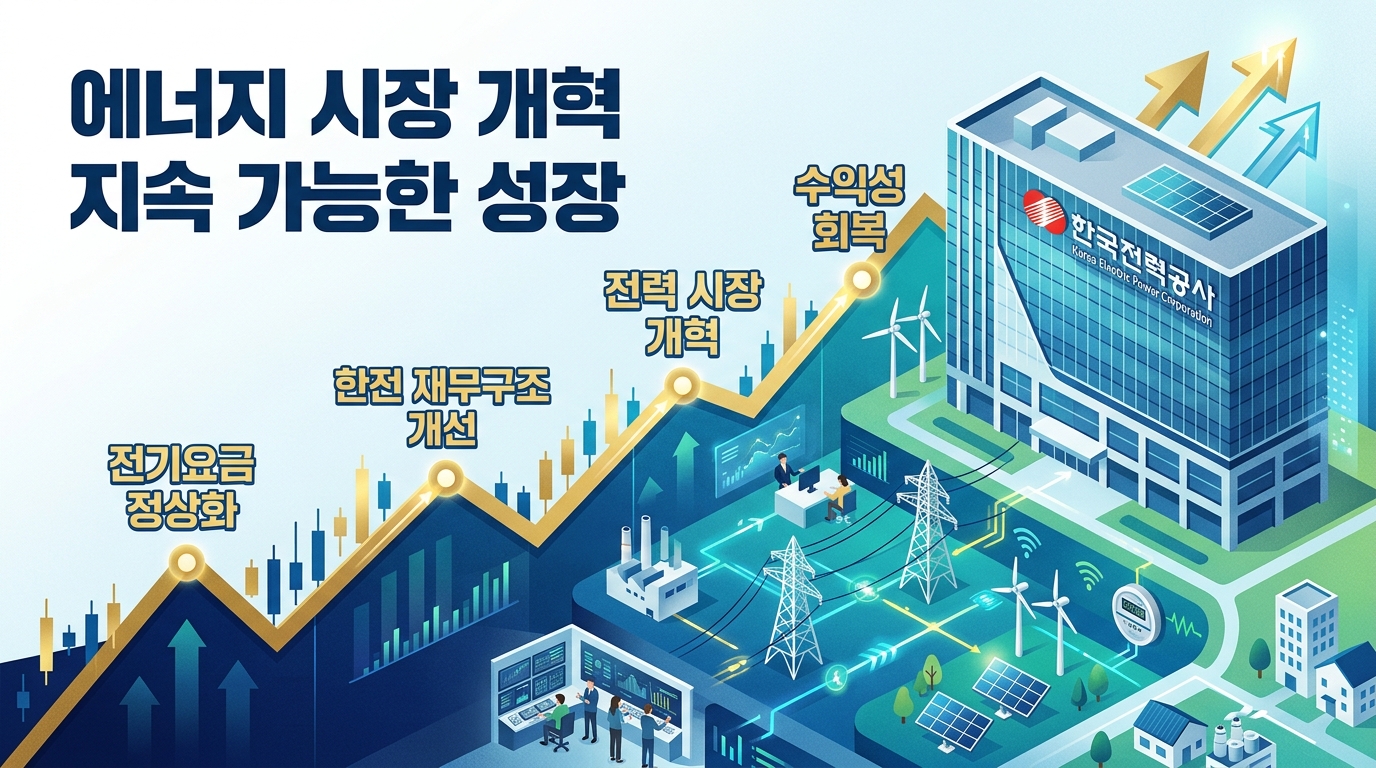
To overcome its long-term financial crisis, KEPCO embarked on a major overhaul of its electricity rate structure starting June 1, 2026.
This restructuring is not a simple rate hike, but rather focuses on expanding the "seasonal and time-of-use electricity rate system" to small businesses and small-scale workplaces to induce efficient distribution of power demand.
With the KOSPI index hovering around 8,123.62 and the KRW/USD exchange rate maintaining high volatility at 1,519.50, the rate reform of KEPCO—a representative defensive public enterprise—has emerged as a key topic in the market.
According to Daily Stock's own analysis, the KOSPI Fear and Greed Index currently sits at a Neutral level (43.9), and market participants are closely examining the possibility of KEPCO mitigating its cost burden.
With the expansion of this rate system, General (A) II power users operating in general commercial areas or small retail stores will face differentiated rates depending on the time of day.
To cushion the impact of sudden rate changes, the government has prepared safety measures from June to November, such as the "automatic lowest rate system" which automatically calculates the cheapest rate plan.
[Image: /stdaily/uploads/202606/gen_6a2d00d5a6da50.75044546.png]
Financial Analysis
KEPCO's preliminary Q1 2026 earnings reported an operating profit of 3.7842 trillion won, maintaining profitability, although it slightly missed the initial market consensus of approximately 4.2 trillion won.
This was affected by a 2.4% year-on-year decline in industrial power sales due to sluggish manufacturing activity, and an increased proportion of high-cost thermal and gas power generation due to a drop in nuclear power plant utilization rates.
| Classification | 2024 (Confirmed) | 2025 (Annual Est.) | 2026 (Annual Outlook) |
|---|---|---|---|
| **Revenue (Trillion KRW)** | 93.39 | 97.42 | 98.61 |
| **Operating Profit (Trillion KRW)** | 8.36 | 13.49 | 8.34 |
| **Net Income (Trillion KRW)** | 3.62 | 8.66 | 4.93 |
| **BPS (KRW)** | 75,035 (As of end-2025) | - | 88,734 (Expected) |
| **PBR (x)** | 0.32 | 0.63 | 0.50 |
As of the end of 2025, KEPCO's total debt reached approximately 205 trillion won, incurring trillions of won in annual interest expenses alone.
In this context, whether the June rate restructuring can successfully improve KEPCO's power generation mix and substantially lower power purchase costs will be the key to fully escaping the deficit and improving its financial health.
Valuation
As of the close on June 12, 2026, KEPCO's stock price stood at 37,650 won, with a market capitalization of approximately 24.17 trillion won.
Its 52-week price range spans from 27,100 won to 69,500 won, meaning the stock has undergone a correction from its peak.
KEPCO's Price-to-Book Ratio (PBR) currently hovers around 0.5x, reflecting a severe undervaluation compared to its asset value.
Generally, because it trades at a lower multiple compared to the average Price-to-Earnings Ratio (PER) of the broader power utility sector, analysts note that a valuation re-rating is possible once confidence in its cost recovery is established.
Expert and Institutional Analysis
Securities firms are offering somewhat contrasting analyses regarding KEPCO's second-half outlook and target stock prices.
While some institutions lowered their target prices citing an intensifying cost burden, buy ratings highlighting policy benefits remain equally strong.
Eugene Investment & Securities maintained its "STRONG BUY" rating with a target price of 92,000 won in its report dated June 12, 2026.
According to this analysis, the potential re-implementation of the SMP cap to manage Middle East risks in the second half, combined with the normalization of nuclear power plants including the restart of Kori Unit 2, could lead to strong earnings leverage driven by fuel cost savings and mix improvements.
Conversely, Kiwoom Securities maintained its target price at 48,000 won, pointing out that rising liquefied natural gas (LNG) and international crude oil prices, fueled by Middle East geopolitical instability, could pose cost pressures on the utility sector.
The high KRW/USD exchange rate of 1,519.50, which directly impacts raw material import prices, is another factor that could add to the cost burden.
Risk Factors
The largest external risk facing KEPCO is the potential surge in raw material import prices due to persistent geopolitical conflicts in the Middle East.
In general, imported international energy prices are reflected in the domestic wholesale electricity price (SMP) with a lag of about 3 to 5 months.
Furthermore, there is a possibility that further normalization of electricity rates in the second half of the year could be limited due to a domestic economic slowdown and government policies aimed at stabilizing consumer inflation.
If a structure where costs rise but rate hikes remain frozen becomes entrenched, concerns remain that interest expenses from massive debt will continue to strain KEPCO's profitability.
[Image: /stdaily/uploads/202606/gen_6a2d00e072c036.32638772.png]
Investment Outlook Summary
KEPCO's investment appeal depends on whether the balanced distribution of power demand by time of day works organically with the company's carbon-free power supply chain.
If the time-of-use rate restructuring introduced in June successfully guides demand patterns in commercial and industrial sectors, it could lower the utilization rate of high-cost LNG power plants, securing long-term profit stability.
At the same time, investors need to monitor multi-dimensional factors in the second half, including global nuclear export momentum such as Korea-US nuclear cooperation, and the successful restart of major baseload power sources like the Kori nuclear power plant.
Amid a high exchange rate environment, a conservative yet opportunistic split-purchase approach is recommended while checking scenarios for policy tools to curb cost burdens.
FAQ
Q1. What are the key changes in the June electricity rate restructuring?
A1. The core is to encourage voluntary demand shifts by lowering rates during afternoon hours (11:00-15:00) when power supply is abundant, and raising rates during evening peak hours (18:00-21:00) when demand surges and generation costs are high.
Q2. How will the restructuring affect self-employed individuals and small business owners?
A2. Businesses operating mainly during daytime hours, such as cafes and hair salons, may benefit from lower electricity bills. However, businesses with high evening or nighttime usage, like internet cafes, gyms, and restaurants, may face higher costs. A buffer system that automatically calculates the most favorable rate plan will remain in place until November to ease the transition.
Q3. How will KEPCO's debt of 205 trillion won be addressed?
A3. Efforts to address the debt include cutting power purchase costs through this restructuring, increasing the utilization of nuclear plants such as Kori Unit 2, and implementing mid-to-long-term rate normalization along with government measures for stable funding.
Q4. Why is there a large discrepancy in KEPCO's target prices among securities firms?
A4. The variance stems from different cost assumptions. Some institutions focus more on the risk of rising global oil prices and SMP due to geopolitical risks (target price in the 40,000-60,000 won range), while others take a more optimistic view of policy defenses in the second half, including improved nuclear plant operations and the potential revival of the SMP cap (target price up to 92,000 won).
Q5. What are the key indicators that investors should monitor closely?
A5. Key metrics include global energy (crude oil and LNG) price trends, domestic SMP price movements reflecting these costs, policy benefits like Korea-US nuclear cooperation, and the recovery trend of KEPCO's quarterly power sales volume.