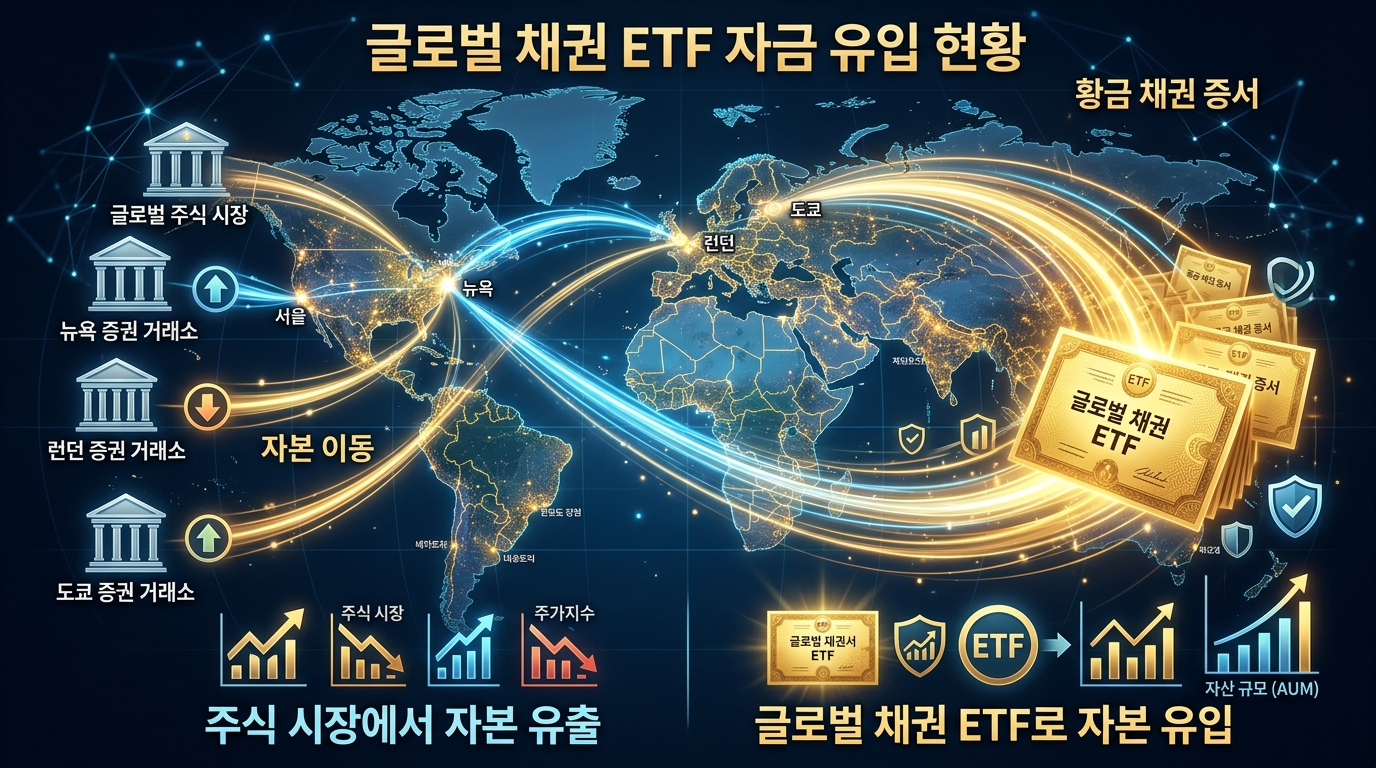
As global interest rate volatility intensifies, global investors are shifting historic volumes of capital into bond ETFs, embarking on a major portfolio realignment.
Executive Summary
- **Record Bond Inflows**: In May 2026 alone, US-listed bond ETFs saw a historic net inflow of $64 billion (approx. KRW 88 trillion), cementing fixed-income ETFs as a powerful growth engine in the market.
- **Tri-Polar Decoupling & Rate Trends**: While the US 10-year Treasury yield surged to the 4.6% level amid the Federal Reserve's higher-for-longer stance (3.50%–3.75%), Europe (ECB holding at 2.0%) and Asia (Japan's BOJ normalizing, Bank of Korea initiating a 2.75% cut cycle) are showing distinct gaps in fundamentals and monetary policies.
- **Margin of Safety & Duration Plays**: To avoid the capital loss risks of long-term bonds, investors are flocking to ultra-short bond and high-yield "core aggregate bond" ETFs to lock in high carry trades early.
[Image: /stdaily/uploads/202606/gen_6a2c57920df158.59993558.png]
Market Overview
Currently, the global financial markets are experiencing a peak in monetary policy decoupling across three major economic blocs: the US, Europe, and Asia.
The US Federal Reserve (Fed) continues to freeze its benchmark interest rate at 3.50%–3.75%, maintaining a cautious, hawkish stance due to concerns over sticky inflation.
Consequently, the US 10-year Treasury yield briefly crossed the 4.6% mark, and the 30-year Treasury yield climbed to 5.2%, creating an attractive undervaluation phase for bond prices.
Meanwhile, the European Central Bank (ECB) is walking a tightrope between defending against economic slowdown and stabilizing inflation, keeping its benchmark interest rate locked at 2.0% amid services inflation volatility.
In the Asian market, the Bank of Korea has preemptively lowered its benchmark rate to 2.75% to lead a rate-cut cycle. At the same time, anticipation is building for large-scale foreign capital inflows ahead of South Korea’s full inclusion in the World Government Bond Index (WGBI) in November 2026.
Against this macroeconomic backdrop, investors are fleeing to bond ETFs to lock in reliable yields and reduce exposure to top-heavy equity markets.
As of June 13, 2026, major domestic and international market indicators are as follows:
- **KOSPI**: 8,123.62
- **KOSDAQ**: 1,029.05
- **NASDAQ**: 25,869.48
- **USD/KRW Exchange Rate**: 1,517.40 KRW
- **KOSPI Fear & Greed Index**: Neutral (43.9)
- **NASDAQ Fear & Greed Index**: Fear (30.9)
The NASDAQ Fear & Greed Index entering the "Fear" zone (30.9) reflects mounting wariness stemming from rate rebounds and heightened volatility in tech stocks.
Financial Analysis
A quantitative analysis of flows into the bond ETF market reveals a smart migration of capital aimed at maximizing "high in-carry yields," rather than a simple flight to safety.
In particular, the concentration of capital into US-listed ultra-short Treasury ETFs (such as SGOV) and aggregate investment-grade bond ETFs (such as BND and AGG) is pronounced.
The following table summarizes the capital inflows and expected yields of key global bond ETFs:
| ETF Ticker | Primary Underlyings | May 2026 Inflows | Representative Duration (Years) | Expected Pre-tax Yield (Latest) |
|---|---|---|---|---|
| **SGOV** | US Ultra-Short Treasuries (0-3 Months) | ~ $11.7B (Consolidated ultra-short) | ~ 0.11 | ~ 3.54% – 3.67% |
| **BND** | US Aggregate Investment-Grade Bonds | ~ $13.1B (YTD Cumulative) | ~ 6.1 – 6.5 | ~ 4.40% |
| **AGG** | US Core Aggregate Bonds | ~ $15.3B (Consolidated Treasury/Agency) | ~ 6.2 | ~ 4.35% |
| **EMD Series** | Emerging Markets Local Currency Bonds | ~ $3.8B (Consolidated international bonds) | ~ 5.5 – 7.0 | ~ 6.20% – 7.10% |
In the case of SGOV, which holds ultra-short US Treasury bills, the duration is a mere 0.11 years, virtually eliminating price risk from rate fluctuations while delivering an annualized distribution yield of over 3.5%, serving as a reliable haven for cash-like assets.
On the other hand, core aggregate bond ETFs like BND and AGG are attracting massive buy orders from long-term investors betting on a "rate peak" as Treasury yields spike amid delayed rate-cut expectations.
[Image: /stdaily/uploads/202606/gen_6a2c579e5678f8.16469875.png]
Valuation
The current valuation of the global bond market sits at the upper end of its historical band, making price entry points highly attractive.
The US 10-year Treasury yield hovering near 4.6% is significantly higher than its 15-year average of 2.5%, implying that absolute bond prices are deeply undervalued.
Compared to the valuation burdens of tech giants that led the stock market rally, the high risk-free equivalent yields offered by bonds maximize their relative asset allocation appeal.
Furthermore, even though spreads between investment-grade (IG) corporate bonds and government Treasuries remain tight, the high absolute all-in yields sustain the appeal of credit bonds. The emerging market debt (EMD) sector is also benefiting from valuation re-rating, serving as a high-yield (>6% annualized) alternative for institutional investors supported by solid fundamentals and downward pressure on the US dollar.
Expert & Institutional Analysis
BlackRock’s fixed-income analysis team noted: "The current flow into bond ETFs is not just a defensive positioning, but a 'precise duration allocation' targeting specific maturity brackets." Rather than blindly taking on the high volatility of long-term bonds, investors are splitting and deploying capital into 5–7 year mid-term or ultra-short maturities.
Fidelity Management remarked: "While inflationary pressures persist due to volatile energy prices and geopolitical tensions, keeping rates high, this actually provides bond investors with a solid 'starting yield' cushion." Thanks to this high-yield starting point, bond coupon income should comfortably offset capital losses even if interest rates fluctuate.
State Street (SSGA) also highlighted: "Of the $64 billion that flowed into bond ETFs in May, active bond ETFs accounted for a record high of approximately $22 billion." This indicates a growing preference for active fixed-income products where professional managers can flexibly adjust portfolios during market volatility.
Risk Factors
- **Sticky Services Inflation**: If services inflation in the US and Europe fails to cool down as fast as hoped, central banks may completely take rate cuts off the table or even hike rates, triggering further drops in bond prices.
- **Geopolitical and Oil Price Shocks**: Escalating tensions in the Strait of Hormuz or other geopolitical hotspots could cause crude oil prices to spike, reigniting supply-side global inflation.
- **Fiscal Deficits and Treasury Oversupply**: The US government's massive fiscal deficit spending and subsequent surge in Treasury issuance present a chronic supply-demand risk that can push bond yields up (and prices down).
Investment Outlook
In a phase of tri-polar fundamental decoupling, investing in global bond ETFs can be key to securing stable cash flows and hedging against volatility.
For investors seeking high absolute yields centered on the US, a strategy focusing on ultra-short Treasury ETFs (like SGOV) to lock in over 3.5% yields with minimal rate risk, or core aggregate bond ETFs (like BND and AGG) yielding mid-4% looks highly favorable.
Concurrently, to capitalize on Asia-specific catalysts—specifically, foreign capital inflows driven by South Korea's inclusion in the WGBI—investors might consider a barbell strategy, blending long-term domestic government bond ETFs or currency-hedged US Treasury ETFs.
However, given the lingering potential for geopolitical events to spike oil prices and the Fed to prolong monetary tightening, it is prudent to diversify entry prices via dollar-cost averaging and include some active bond ETFs that can adapt dynamically to market shifts.
Investor Q&A Checklist
Q1. Why are such historic amounts of capital flooding into global bond ETFs recently?
A1. Yields have hit multi-year highs, with the US 10-year Treasury yield reaching the 4.6% range. This has ignited explosive demand from investors looking to secure stable, high interest income compared to equities.
Q2. Won't bond ETFs lose money if interest rates go up further?
A2. When interest rates rise, existing bond prices fall, which can lead to short-term paper losses. However, investors are mitigating this risk by utilizing ultra-short (0-3 month) Treasury ETFs, which have virtually zero interest rate sensitivity due to their extremely short maturities.
Q3. What is the difference between ultra-short Treasury ETFs (like SGOV) and aggregate bond ETFs (like BND and AGG)?
A3. SGOV invests exclusively in ultra-short-term US Treasury bills with maturities of under 3 months, offering stable short-term interest with almost zero interest rate risk. On the other hand, BND and AGG diversify across various maturities (averaging around 6 years), including high-quality corporate bonds and mortgage-backed securities, allowing investors to also target capital gains when rates fall.
Q4. Is there any positive catalyst to watch in the Korean bond market?
A4. Korean government bonds are being phased into the World Government Bond Index (WGBI), with full inclusion slated for November 2026. This is expected to draw approximately KRW 90 trillion in global tracking capital into the Korean bond market over the long term, acting as a supportive factor for domestic bond price stability.
Q5. When are active bond ETFs more advantageous than passive bond ETFs?
A5. When monetary policies diverge across countries and inflationary or geopolitical variables are frequent—like now—active bond ETFs can be superior. Unlike passive ETFs that track a fixed index, active funds allow managers to flexibly adjust duration and credit ratings to better defend capital and generate excess returns.