[Image: /stdaily/uploads/202606/gen_6a290bd43a03d3.20969964.png]
Hello, this is Daily Stock, your source for in-depth analysis of market trends and corporate value.
Key Summary
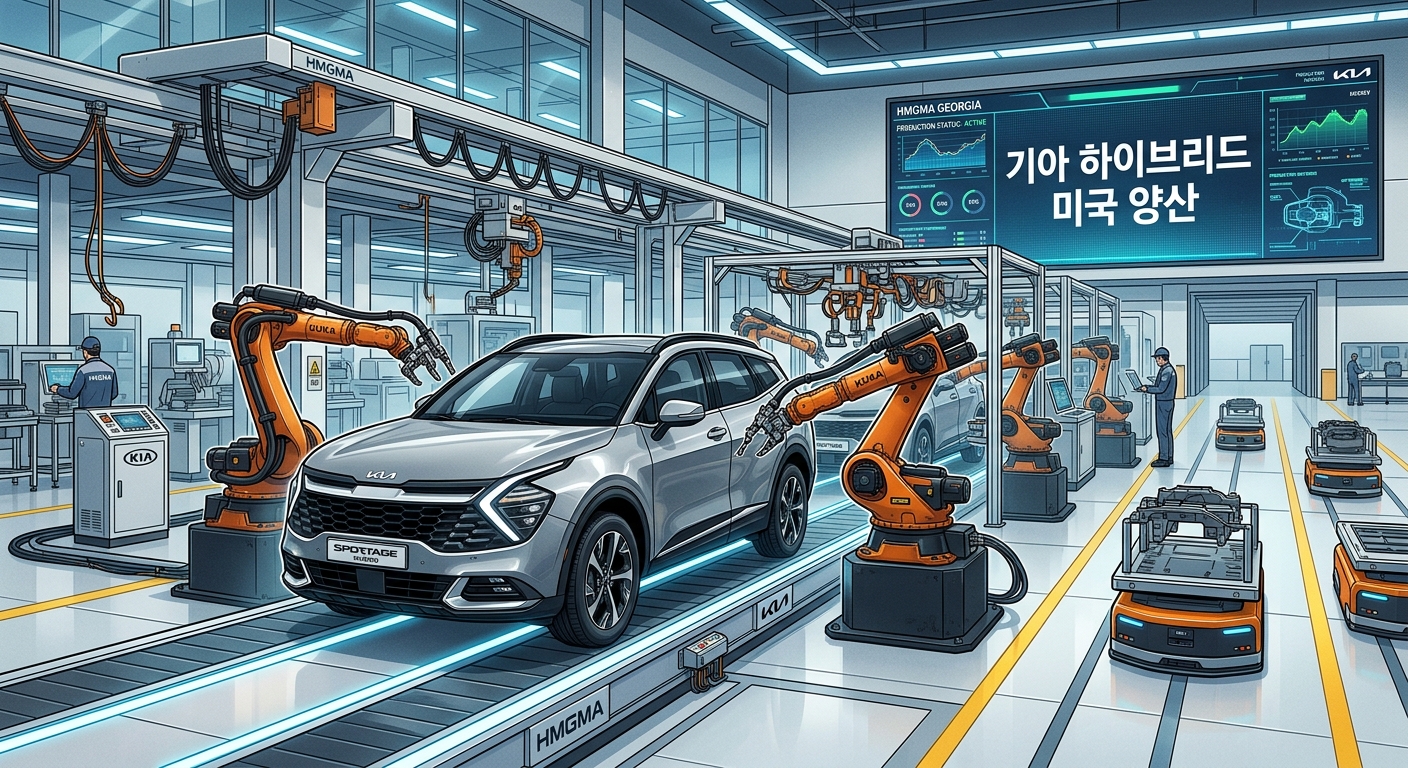
Kia has officially commenced mass production of its best-selling SUV model, the "Sportage Hybrid (HEV)," at Hyundai Motor Group Metaplant America (HMGMA), the group's new plant in Georgia, USA.
By transitioning from exporting fully assembled vehicles from its Gwangju plant in South Korea to local manufacturing, the company is expected to bypass the 15% auto tariff on US imports, driving substantial cost savings and securing stronger profit margins.
Current Status Overview
HMGMA, initially designed as an electric vehicle (EV) dedicated plant, swiftly pivoted to a flexible mixed-production system capable of assembling hybrid vehicles to counter the global EV chasm (demand stagnation). The Sportage HEV is the very first Kia model and the first hybrid vehicle to be manufactured at this facility.
As of the closing on June 10, 2026, Kia's (000270) share price closed at 162,000 KRW, down 2,300 KRW (-1.40%) from the previous day, with a trading volume of approximately 200,000 shares. In a high-exchange-rate environment where the KRW/USD exchange rate reaches around 1,524.80 KRW, Kia's localized production strategy in the US serves as a buffer, partially offsetting the risk of rising raw material and component costs driven by the weak Korean won.
Currently, Daily Stock's proprietary Fear & Greed Index stands at 31.4 (Fear) for KOSPI and 33.5 (Fear) for NASDAQ, indicating highly subdued market sentiment overall. Nevertheless, Kia is actively responding with solid fundamental earnings power and the clear momentum of tariff circumvention.
Financial Analysis
Kia has set its 2026 annual global wholesale sales target at approximately 3.35 million units, presenting solid annual guidance with expected revenue around 112.3 trillion KRW and operating profit around 10.2 trillion KRW.
If the tariff costs previously incurred on export volumes are saved, it will combine with Kia's strong product mix improvement to act as a lever that further boosts operating profit margins in the North American region.
| Classification | 2024 (Actual) | 2025 (Actual) | 2026 Guidance & Forecast |
|---|---|---|---|
| **Global Wholesale Sales** | Approx. 3.0 million units | Approx. 3.15 million units | 3.35 million units (Target) |
| **Annual Revenue** | - | - | 112.3 trillion ~ 122.3 trillion KRW |
| **Annual Operating Profit** | - | - | 10.2 trillion KRW (Target) |
| **Earnings Per Share (EPS)** | - | 18,001 KRW (TTM) | 20,836 KRW (Forecast) |
| **Dividend Yield** | - | 4.49% | Est. 4.14% ~ 4.49% |
[Image: /stdaily/uploads/202606/gen_6a290be1b6e9b5.10440837.png]
Valuation
With 390,412,998 outstanding shares, Kia's market capitalization stands at approximately 63.24 trillion KRW based on the closing price of 162,000 KRW on June 10, 2026, ranking 11th on the KOSPI market.
Kia's price-to-earnings ratio (PER) currently ranges between 7.8x and 8.4x, while its price-to-book ratio (PBR) remains at 0.96x, highlighting undervalued attractiveness below its liquidation value in absolute terms. Coupled with active shareholder return policies such as treasury stock cancellations and profitability re-rating via localized production, Kia is cementing its position as a key beneficiary of the government's "Corporate Value-Up Program."
Analyst & Institutional View
The financial investment industry and major domestic brokerages have set Kia's 12-month average target price at around 227,833 KRW, and even conservative institutional views assess its fair value above 170,000 KRW.
Experts analyze that beyond simple hardware manufacturing competitiveness, the scalability of future "Physical AI" platforms, robotics, and emerging market Purpose-Built Vehicle (PBV) lineups will be key to elevating Kia's multiple. In particular, the local procurement of the Sportage HEV, given the high preference for SUVs in the US market, is receiving praise as a powerful promotional weapon for dealer networks.
Risks
Rising raw material and energy prices due to global geopolitical uncertainties, along with inflationary pressures, pose a potential threat that could inflate Kia's cost of goods sold.
Furthermore, as competition for market share among automakers in the US intensifies, the size of incentives (promotional spending) per vehicle is on the rise. Therefore, a scenario remains where local production cost savings could be partially diluted by incentive competition.
Investment Perspective Summary
In short, the full-scale operation of hybrids at Georgia's HMGMA can be summarized as an optimal, flexible tactical move to neutralize trade barriers and maintain leadership in the US market.
While volatility may persist in the short term due to macroeconomic uncertainties and a jittery KOSPI fear index, Kia's resilience as a large-cap auto stock with robust defensive earnings power and high dividend appeal is highly likely to remain intact.
[Image: /stdaily/uploads/202606/gen_6a290bee912451.09695692.png]
Investor Checklist Q&A
Q1. Why did Kia suddenly start mass-producing hybrids at HMGMA in the US?
* A1. To respond nimbly to the slowing growth rate of EV demand in the US and flexibly address the surging demand for hybrid vehicles instead, Kia converted its EV-dedicated line into an advanced smart factory capable of mixed hybrid production.
Q2. What is the specific tariff reduction benefit from this local production of the Sportage Hybrid?
* A2. Previously, units exported in full-vehicle form from the domestic Gwangju plant to the US were subject to an auto tariff of approximately 15% upon US customs clearance. Transitioning to local production brings substantial financial restructuring benefits by completely eliminating this 15% tariff burden and long-distance transportation costs.
Q3. What are Kia's mid-to-long-term production capacity targets in the US?
* A3. Based on the combined manufacturing capacity of its existing standalone factory in West Point, Georgia, and the new HMGMA facility, Kia has established a roadmap to build a large-scale manufacturing system capable of producing up to 550,000 units annually in the North American market by 2030.
Q4. Does the persistent high exchange rate around 1,520 KRW work against Kia's earnings?
* A4. Kia is a representative beneficiary of a high exchange rate. Because of its high proportion of overseas sales, a strong dollar is a positive factor that maximizes operating profit when translated into KRW. However, localizing production bases to prepare for prolonged macroeconomic volatility is also an important hedging strategy to control exchange rate exposure risk.
Q5. From an investor's perspective, how credible are Kia's shareholder return policies and value-up initiatives?
* A5. Kia is a leading "Value-Up" enterprise with a strong shareholder-return orientation, boasting a dividend yield of around 4.49%. In addition, by continuously executing practical shareholder-friendly policies, such as the treasury stock cancellation program announced early this year, it continues to foster a favorable supply-demand environment to escape its low PBR territory.