Hello, this is the professional editor at Daily Stock.
Executive Summary
As of June 14, 2026, international oil prices are experiencing a sharp decline due to easing geopolitical tensions between the U.S. and Iran, alongside expectations of the reopening of the Strait of Hormuz.
The energy sector, which has posted overwhelming performance within the S&P 500 since the beginning of the year, is now facing a test of its earnings defense capability and shareholder return sustainability amid recent downward pressure on oil prices.
In this article, we closely examine the valuation re-rating scenarios and key risk factors for S&P 500 energy companies as WTI oil prices retreat to the $84 range.
Current Situation Overview
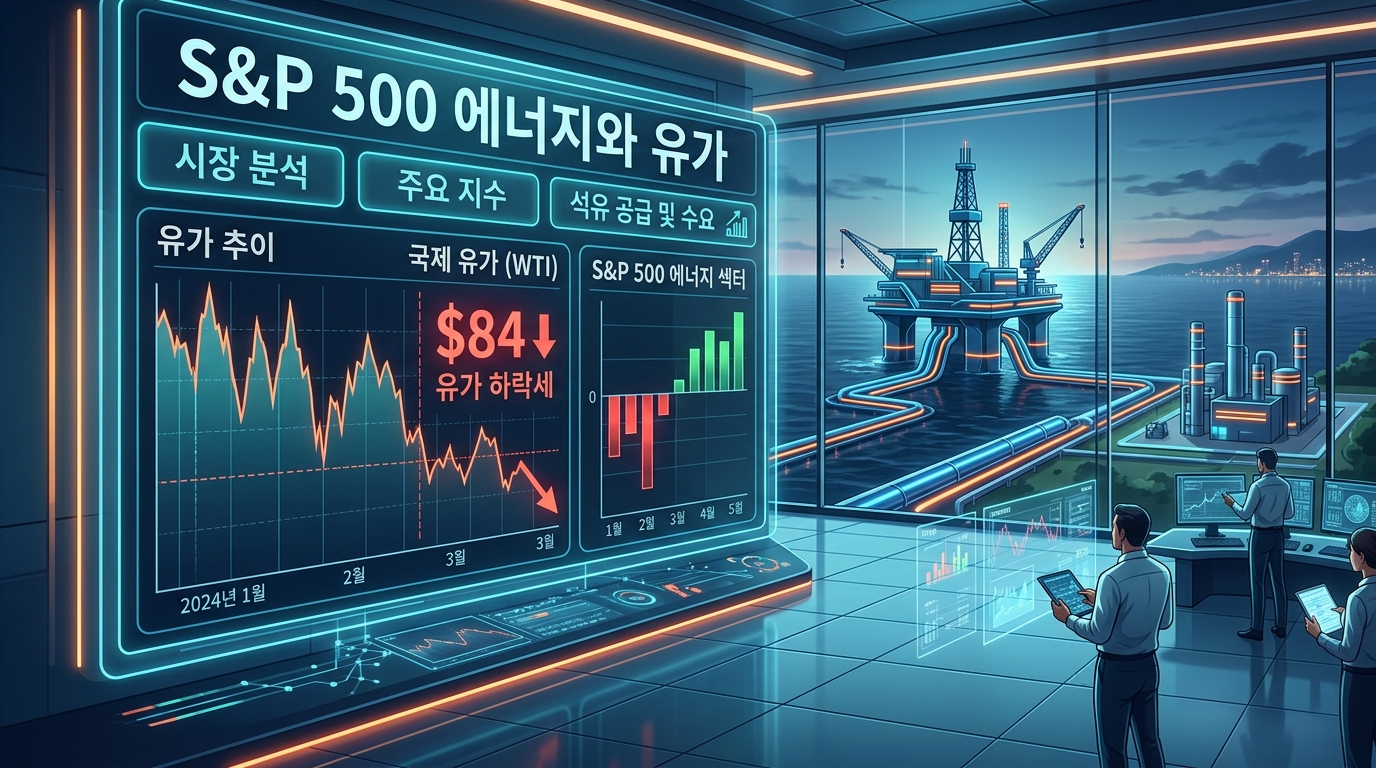
On June 11–12, hopes of a dramatic agreement between the two nations following U.S. President Donald Trump's withdrawal of airstrike threats against Iran pushed West Texas Intermediate (WTI) crude prices down to the $84.85 level per barrel (as of the June 12 closing price, down -1.42% from the previous day).
Brent crude, the global benchmark, also slipped to the $84–$87 range, rapidly cooling the oil rally that had surged due to escalating geopolitical conflicts in the spring.
As a result, while the S&P 500 energy sector still boasts a high year-to-date return of over 28%, it has entered a correction phase from its peak as short-term profit-taking emerged due to falling oil prices.
[Image: /stdaily/uploads/202606/gen_6a2dff0bc3d496.88427577.png]
Notably, as of June 14, the Nasdaq Fear and Greed Index stood at 34 (Fear), reflecting expanded market volatility. Consequently, supply-demand rebalancing in the highly cyclical energy sector is accelerating.
If the Strait of Hormuz is fully reopened, concerns over a supply disruption of more than 11 million barrels per day would be resolved, raising the possibility of rekindling oversupply concerns.
Financial Analysis
Unlike past aggressive capital expenditure (CAPEX) competition, S&P 500 energy companies have extremely curbed capital spending over the past few years, solidifying a robust foundation for organic free cash flow (FCF) generation.
Large integrated oil majors, including industry leader ExxonMobil (XOM), support their investment appeal by offering high total shareholder yield (dividend yield + buyback yield) of approximately 5% to 7%.
Independent exploration and production (E&P) companies, such as Devon Energy (DVN), are also bolstering downside support for their stock prices by maintaining guidelines that allocate up to 70% of free cash flow to dividends and share buybacks.
[Image: /stdaily/uploads/202606/gen_6a2dff19684d77.06302131.png]
This dividend stability serves as a solid anchor for global energy giants like Shell (Shell, dividend yield 3.64%), which has maintained its dividend for 22 consecutive years.
| Category | Key Metrics & Figures | Features & Remarks |
|---|---|---|
| WTI Crude Oil Price (6/12 Close) | $84.85 per barrel | Trending down on expectations of the Strait of Hormuz reopening |
| S&P 500 Energy YTD Return | Approx. +28.69% (as of 6/10) | Remains at the top tier year-to-date despite temporary corrections |
| Shareholder Return Rate of Major Giants | Approx. 5.0% ~ 7.0% | Supported by high dividends and active share buyback programs |
| Average Dividend Yield Range | Approx. 3.3% ~ 4.2% | Overwhelming advantage compared to the S&P 500 average (1.1%~1.3%) |
Valuation
The forward price-to-earnings (P/E) ratio of the S&P 500 energy sector stands at around 11 to 13 times, remaining at a significant discount compared to the overall S&P 500 index average of 21 times.
However, if oil prices drop below the $80 level, there is a risk that forward P/E multiples could appear slightly higher due to preemptive downward revisions of second-half earnings per share (EPS) estimates.
Market experts evaluate that as long as oil prices remain above $75 per barrel, the energy sector's cash-generating capacity is sufficient to cover annual dividends and committed share buyback programs.
Expert and Institutional Analysis
Global investment banks like Goldman Sachs highlight the value and defensive asset characteristics of the traditional energy sector amid prolonged global tightening and supply chain restructuring in the second half of the year.
In its latest monthly sector outlook, Charles Schwab Research strongly recognized the short-term EPS estimate improvements in the energy sector, while also suggesting the need for gradual weight adjustments, citing whether the peak of high oil price benefits has passed.
In addition, energy analysts point out that nuclear power and natural gas grid utility companies are emerging as new energy leaders from the perspective of diversifying 'power sources' to accommodate the expansion of AI data centers, beyond just crude oil.
[Image: /stdaily/uploads/202606/gen_6a2dff2492b908.81728376.png]
Risk Factors
The most direct risk is a volatile scenario where the U.S.-Iran agreement suddenly falls through or geopolitical tensions reignite, causing oil prices to fluctuate again.
Conversely, if the Strait of Hormuz is reopened quickly and global supply recovers rapidly toward nearly 11 million barrels per day, oil prices could quickly settle below the $70s range, increasing margin compression pressure.
Additionally, the exceptionally high USD/KRW exchange rate of 1519.50 won as of June 14 imposes complex financial burdens on Korean investors due to foreign exchange volatility exposure.
Investment Perspective Summary
The S&P 500 energy sector has ample potential to continue acting as a solid 'cash cow' in portfolios, backed by strong shareholder return (buybacks and dividends) capabilities.
However, at this point where oil prices have retreated to the $84 range, it is time to carefully evaluate the equilibrium price level after the geopolitical premium is removed and separate individual companies' production margin structures.
Rather than chasing momentum from short-term peak breakouts, a scenario-based approach focusing on the downside support of dividend yields and valuation attractiveness is expected to be more effective.
Investor Checkpoints Q&A
Q1. What is the main reason for the recent plunge in WTI crude oil prices to the $84 range?
A1. The market preemptively priced in the easing of supply concerns following expectations of the Strait of Hormuz reopening, as U.S. President Donald Trump withdrew airstrike threats against Iran, sparking high hopes for a tentative bilateral agreement.
Q2. If oil prices fall, will the stock prices of the S&P 500 energy sector immediately plunge as well?
A2. While declining oil prices may trigger short-term profit-taking desires, most energy companies maintain solid dividend policies and share buyback programs, providing excellent defensive strength compared to typical commodity price declines.
Q3. How attractive is the current average valuation (Forward P/E) of the S&P 500 energy sector?
A3. It is currently at around 11 to 13 times. Compared to the overall S&P 500 index average valuation of about 21 times, it trades at a relatively lower multiple, indicating long-term valuation attractiveness.
Q4. What is the impact of exchange rate volatility on Korean investors?
A4. Since the USD/KRW exchange rate is hovering at a high of 1519.50 won as of June 14, making new purchases of U.S. energy stocks carries risks of foreign exchange losses, which could negatively impact final investment returns if the dollar weakens in the future.
Q5. Are there any newly emerging growth engines in the energy sector other than crude oil?
A5. With massive power infrastructure becoming essential for AI data centers, companies that have secured utility partnerships in natural gas grids and renewable energy, including nuclear power, are drawing attention as mid-to-long-term investment alternatives.